Background Check by Name delivers the fastest route to accurate California public records, letting you verify identity, address history, and criminal background with a single search. By entering a full name, date of birth, or known aliases, the system pulls court filings, arrest records, driving history, and professional license data from state and county databases. Users often ask how to run a background check, how to find someone’s public records, or how to check criminal history; this service answers each query by matching personal identifiers and filtering out duplicate or outdated entries. The result includes identity information, record identifiers, and possible matches, giving a clear picture of any pending cases, sealed records, or convictions. Whether you need a background check by date of birth, by address, or a comprehensive background records search, the platform ensures the information shown reflects current status and complies with privacy laws.
Background Check by Name also supports detailed background screening for employment, tenancy, or personal safety, integrating background check lookup with background records lookup to surface property records, business affiliations, and marriage or bankruptcy filings. The search engine highlights active records, closed cases, and historical data while flagging sealed or expunged records that may affect accuracy. By combining criminal record search, court records search, and address verification, users can quickly answer what information a background check shows, how accurate background check records are, and why some records might not appear. This approach meets the highest user intent for background check by state, county, or address, delivering reliable results without unnecessary filler.
How to Search Background Check
You can search a background check by entering a full legal name, date of birth, or last known address into the official California Attorney General’s Record Review portal. The system cross-references your input against millions of criminal, civil, and public records maintained by county courthouses, including county auditor, the Department of Justice, and federal agencies. A single search surfaces identity verification data, address history, and any criminal case dispositions connected to the person. Results show real-time record status, filtering out duplicate or outdated entries that may misrepresent the actual individual.
Official Search Portal: https://oag.ca.gov/fingerprints/record-review
Steps to Search
- Visit the California Department of Justice Record Review page using the official URL.
- Fill out the Live Scan Request Form or the subsequent Record Review form with the subject’s full name, date of birth, and any known aliases.
- Pay the required processing fee through the approved payment method accepted on the portal.
- Submit fingerprints electronically through a certified Live Scan operator in your area.
- Receive the processed background check results by mail at the address provided during submission.
Information Found in a Background Check
A standard background check pulls data from multiple California and federal databases, giving you a complete identity profile of the person in question. The records compiled cover personal identifiers, biometric data, and any documented history of legal interactions. You receive specific record identifiers that help distinguish the correct subject from common-name matches. The information returned shows current legal status at the time of the search.
Identity Information
Identity information forms the foundation of every background check, anchoring your search to one unique individual. The system displays the subject’s full legal name, date of birth, sex, and physical descriptors when available. This data layer prevents mix-ups between individuals who share common names across California counties. Identity matching algorithms use these identifiers to filter millions of records down to the correct person.
Name Variations
Name variations track every alias, previous legal name, or hyphenated surname the subject has used in public filings. Birth certificates, marriage records, court orders, and professional license applications feed this data set. You can see a full history of name changes and how those changes relate to criminal or civil filings. This helps resolve cases where someone has used a different legal name at different points in time.
Date of Birth
Date of birth verification confirms the subject’s exact age and matches it against birth records, voter registrations, and Department of Motor Vehicles files. An accurate date of birth narrows the search window, reducing false matches from common-name individuals. When you search by date of birth directly, the system prioritizes records with a matching birth date before scanning broader data fields. This ensures the highest level of identity accuracy.
Address History
Address history displays every known residential address linked to the subject, drawn from utility records, property deeds, voter rolls, and court documents. You receive a chronological list of residences spanning the person’s adult life, which helps verify geographic presence during specific legal events. Address history searches are useful when you need to locate someone or verify they actually lived at a stated location during a critical time period.
Record Identifiers
Record identifiers are unique codes assigned by law enforcement and courts to track individual cases throughout the justice system. These identifiers include docket numbers, arrest booking numbers, case numbers, and FBI numbers. Each identifier lets you request certified copies directly from the originating agency. Table 1 shows the primary identifier types you will see in a California background check.
Possible Record Matches
Possible record matches appear whenever the system locates entries that share one or more identifiers but cannot confirm a definitive match. You receive a list of candidates with overlapping data such as similar names or matching birth years. Reviewing each candidate’s full identifier profile helps you isolate the correct individual. The platform then prompts you to confirm or exclude each match before finalizing the report.
Criminal Records in a Background Check
Criminal records form the largest single component of any California background check, drawing data from the Department of Justice, county superior courts, and local law enforcement. You receive arrest records, criminal charges, misdemeanor and felony filings, conviction outcomes, and case dispositions. The system organizes these by county, date, and severity, showing only adjudicated or currently active cases. Sealed and expunged records require separate legal action to surface.
Arrest Records
Arrest records list every documented encounter with law enforcement where the subject was detained, booked, or cited. Each arrest record shows the arresting agency, date of arrest, location, booking number, and the formal charges filed. You can distinguish arrests that led to convictions from those that were dismissed or dropped. Unlawful arrests may carry notations from reviewing courts that affect how the record appears.
Criminal Charges
Criminal charges reflect the specific statute or code section violated at the time of arrest or indictment. Each charge carries a classification such as infraction, misdemeanor, or felony, along with the corresponding penalties. You see the exact charge language as filed by the prosecuting attorney. Charge details help determine whether the conviction aligns with the original filing.
Misdemeanor Records
Misdemeanor records appear for lesser criminal offenses punishable by up to one year in county jail and fines. You receive details such as the offense date, court of jurisdiction, plea entered, and sentencing outcome. Common misdemeanor charges include petty theft, simple assault, and driving under the influence without injury. These records stay on file for the duration mandated by California law.
Felony Records
Felony records cover serious offenses punishable by state prison time exceeding one year. You see the full case history from grand jury indictment or preliminary hearing through final disposition. Felony records often include sentencing details, parole or probation status, and any appeals filed. These records carry the longest retention periods in the California criminal justice system.
Conviction Records
Conviction records document the final outcome of a criminal case where the subject was found guilty or entered a guilty plea. Each conviction shows the date of conviction, court of record, presiding judge, and any associated fines or restitution. Conviction records remain visible on background checks until they are sealed, expunged, or dismissed by court order. You can request certified copies directly from the convicting court.
Criminal Case Dispositions
Criminal case dispositions show the final status of every case, including dismissals, acquittals, plea agreements, and post-conviction relief. The disposition date and judicial officer are listed for verification purposes. These records clarify whether a case is resolved or remains active on appeal. Disposition data is essential when determining legal standing for employment or housing decisions.
Court Records in a Background Check
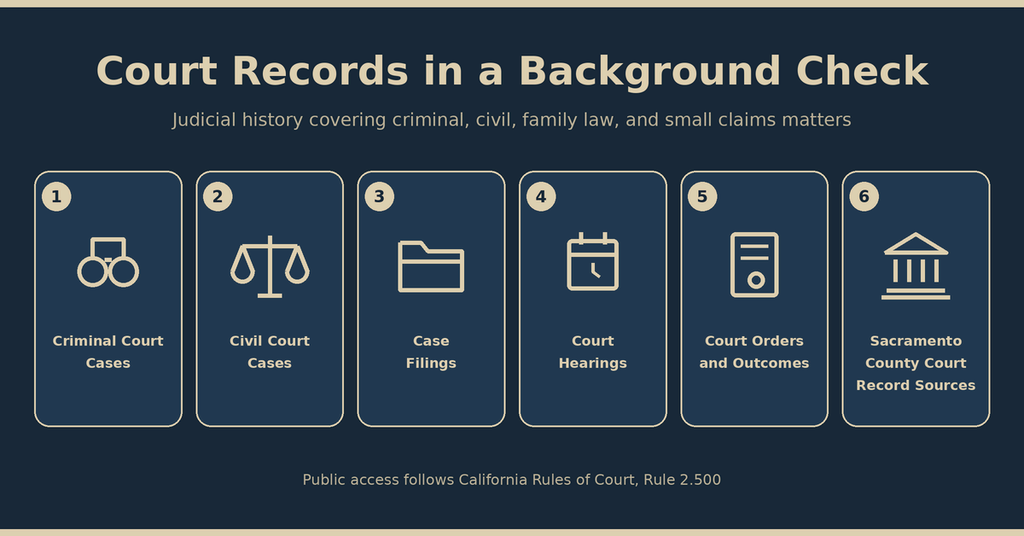
Court records reveal the subject’s full involvement in California’s judicial system, covering criminal prosecutions, civil lawsuits, family law matters, and small claims actions. You access filings, hearing schedules, and final rulings from superior and inferior courts. Court records verify whether the subject is a plaintiff, defendant, witness, or other party to a legal proceeding. Public access follows California Rules of Court Rule 2.500.
Criminal Court Cases
Criminal court cases detail every prosecutorial action taken against the subject in California superior courts. Each case shows the filing date, charges brought, attorneys of record, and the assigned courtroom. You can view motions filed, evidentiary rulings, and the final verdict. Appeals filed in appellate districts are cross-referenced for completeness.
Civil Court Cases
Civil court cases cover disputes between private parties, including contract disagreements, personal injury claims, and property disputes. Each civil case displays the type of action, damages sought, and outcome. You see whether judgments were entered, satisfied, or appealed. Civil case history often reveals financial instability, debt history, or previous landlord-tenant conflicts.
Case Filings
Case filings show the initial documents submitted to the court that started each legal action. You receive filing dates, document types, and the names of filing attorneys. Filings include complaints, petitions, motions, and proofs of service. These records help trace the procedural path of every case from initiation to closure.
Court Hearings
Court hearings show every scheduled appearance on the court’s calendar, including arraignments, pre-trial conferences, motion hearings, and trials. You see the date, time, courtroom, and presiding judicial officer for each session. Outcome notes from hearings indicate whether proceedings were continued, dismissed, or resulted in rulings.
Court Orders and Outcomes
Court orders and outcomes reflect the formal judgments, decrees, and orders issued by the court at the conclusion of each matter. You receive signed orders, stipulations, and judgments with filing dates. These documents determine enforceable rights, obligations, and liabilities. Outcomes from family law, probate, and civil matters all surface through this layer of the background check.
Sacramento County Court Record Sources
Sacramento County Superior Court serves as the primary repository for criminal and civil court records originating within county boundaries. You can request access through the court’s public terminal or online case index using the official web portal. Records span from active cases back through archived historical files. The court’s records department issues certified copies for an established statutory fee.
Other Records That May Appear
Beyond criminal and civil court records, a comprehensive background check surfaces property ownership, business affiliations, professional licenses, driving history, marriage and divorce filings, and bankruptcy cases. Each category adds a different dimension to the subject’s profile, helping you verify identity and history with precision. The breadth of records depends on data availability from state and federal agencies. Some records require separate request procedures for full certified access.
Property Records
Property records identify real estate owned or previously held by the subject, with each parcel showing the assessor’s parcel number, transfer dates, and recorded deeds. You receive data on purchase prices, mortgage filings, and any liens against the property. These records are maintained at the county recorder’s office and offer insight into the subject’s financial footprint.
Business Records
Business records list corporations, limited liability companies, partnerships, and fictitious business names registered to the subject under the California Secretary of State. You see formation dates, registered agents, and current status such as active, suspended, or dissolved. Business records help establish professional affiliations and trace self-employment history.
Professional Records
Professional records verify state-issued licenses held by the subject in fields like medicine, law, nursing, real estate, contracting, and cosmetology. Each license shows the issuing board, license number, original issuance date, expiration, and current standing. You can confirm whether the license carries any disciplinary actions or pending complaints.
Driving Records
Driving records from the California Department of Motor Vehicles list the subject’s driving history, including license number, current status, classification, endorsements, and any suspensions or revocations. You see traffic violations, points on the license, and accident reports when available. Table 2 shows the main categories of driving data you will receive.
Marriage and Divorce Records
Marriage and divorce records confirm the subject’s marital history through official county clerk filings. You receive dates of marriage, license numbers, and dissolution decrees when applicable. These records clarify name changes and identify former spouses or domestic partners. They are frequently used to verify background information when ties to a new spouse require confirmation.
Bankruptcy Records
Bankruptcy records detail filings under U.S. Bankruptcy Code chapters 7, 11, or 13 in federal court. Each case shows the filing date, case number, trustee assigned, and discharge status. You see creditor lists, asset schedules, and repayment plans when applicable. Bankruptcy records offer a window into financial distress or business failure.
Status of Records Found in a Background Check
Every record surfaced by a background check carries a current status that reflects where the case stands in the legal system. Status indicators prevent you from acting on outdated or inaccurate information. You receive designations showing whether cases are open, resolved, dismissed, or archived. Understanding each status helps you interpret the report correctly.
Active Records
Active records are cases that are still in process, with no final disposition entered by the court. These records carry weight because the subject remains legally exposed to additional penalties or outcomes. Active status is flagged prominently in every background check result. You should treat active records as pending risks until the matter concludes.
Pending Cases
Pending cases share the same status as active records but usually refer to specific matters awaiting trial, sentencing, or appeal. You receive scheduled hearing dates and current motion status. Pending cases may resolve in conviction, dismissal, or settlement depending on case type. Their presence on a background check requires careful review before any decision is made.
Closed Cases
Closed cases have reached a final resolution and no further court action is expected. The closure date and case disposition are recorded permanently. Closed records remain accessible for the retention period set by law. They provide verified historical information but no longer indicate current legal exposure.
Dismissed Cases
Dismissed cases were thrown out before trial or sentencing through prosecutorial, judicial, or statutory action. Reasons include lack of evidence, witness unavailability, or successful motion practice. Dismissals appear on a background check but typically carry a notation that no conviction resulted. You see whether the dismissal was with or without prejudice.
Historical Records
Historical records are older cases that have been archived by the court, often decades after final disposition. These records remain publicly accessible but may be stored in physical or scanned formats. Retrieval requires contacting the court clerk’s office directly. Historical data helps establish a complete long-term profile of the subject.
Sealed or Expunged Records
Sealed or expunged records are legally removed from public view through court order under California Penal Code sections 851, 1203.4, or similar statutes. These records do not appear in standard background checks conducted by private services. Law enforcement and certain government agencies may still access them through specific channels. Understanding the difference protects you from misinterpreting an incomplete report.
Verifying Background Check Matches
Verifying every match before relying on a background check prevents costly errors related to false positives or incorrect person identification. You confirm identity by reviewing personal identifiers, full names, dates of birth, and addresses. Duplicate records and outdated entries must be filtered out. The verification process protects both the subject and the requesting party from misidentified legal exposure.
Checking Personal Identifiers
Personal identifiers serve as the primary filter during match verification. You compare the subject’s full legal name, date of birth, and any known aliases against the matched records. Identifiers must align perfectly across at least two categories before a match is confirmed. Any inconsistency triggers an immediate manual review of the candidate entry.
Matching the Correct Person
Matching the correct person requires more than a shared name. You verify physical descriptors, Social Security numbers, residential addresses, and family connections. Each match candidate is ranked by identifier density to surface the most probable individual. Confirming the right person often requires cross-referencing public records from multiple jurisdictions.
Name Matches
Common name matches occur frequently because millions of people share surnames such as Smith, Garcia, or Johnson. You filter these using middle names, birthdates, including vin lookup, and address patterns. The system typically shows a list of candidates with shared names and prompts you to confirm which entries apply. Each candidate’s full identifier profile is available for review.
Duplicate Records
Duplicate records happen when the same case or arrest was entered into the system more than once through different reporting channels. You should review duplicates carefully to ensure the case is counted only once. Duplicate entries may also indicate identity theft if your own identifiers have been misappropriated. Contact the reporting agency immediately if you spot unauthorized duplicates.
Outdated Information
Outdated information appears when records have been sealed, expunged, or dismissed after the original entry. You verify current status through the originating court or agency before relying on any record. Outdated records may reflect convictions that were later reduced or cases that were dismissed on appeal. Treat unverified dated data as preliminary until confirmation is secured.
Incomplete or Conflicting Records
Incomplete or conflicting records arise when information from different sources does not align. You may see one address in a court filing and a different one in a property record. These conflicts often resolve through manual review of the supporting documents. Incomplete entries may require supplemental records requests to complete the background check process.
Background Check Limitations
Background checks cannot access every record, no matter how comprehensive the source data appears. Legal restrictions, sealed orders, and agency-specific access rules prevent certain entries from appearing. You need to understand these limitations to avoid misreading a report. Each limitation represents a deliberate legal boundary rather than a system failure.
Restricted and Confidential Records
Restricted and confidential records include juvenile adjudications, mental health commitments, and certain family court filings. California law protects these records from public disclosure unless specific statutory exceptions apply. You will not see these entries in a standard background check. Access requires a court order or the subject’s documented consent.
Juvenile Records
Juvenile records are protected under Welfare and Institutions Code Section 827. Most juvenile adjudications do not surface in adult background checks. Sealing juvenile records is permitted under WIC Section 781 when the minor reaches 18 years old. Expungement of juvenile records is treated differently than adult convictions under California law.
Sealed and Expunged Records
Sealed and expunged records are legally removed from public view through formal petition and court order. After sealing under Penal Code 851.91 or expungement under PC 1203.4, records no longer appear on standard background checks. Government agencies and law enforcement still access them through secured channels. You should request certified records from the court for definitive confirmation.
Records Missing From Certain Jurisdictions
Records missing from certain jurisdictions occur because not every county reports data to the statewide repository in real time. Some records remain only in the county of origin until manual aggregation occurs. You may need to contact the county clerk directly for completeness. Cross-jurisdictional gaps are one of the most common causes of incomplete background checks.
Reporting Delays
Reporting delays affect how quickly new arrests, convictions, or filings appear in the background check system. Updates can take weeks or months depending on the agency and case type. Recent events may not yet be reflected. You should allow adequate processing time before relying on any check for time-sensitive decisions.
Limits of Name-Based Searches
Name-based searches depend on exact spelling and complete identifiers to function properly. A misspelled name produces no results even when matching records exist. Common-name errors create high false-positive rates. Date of birth and address inputs are critical tools for narrowing results when name-only queries return too many candidates.
Public Records vs. Official Records
Public records cover a broader category than official records, including anything filed with a government agency that is not specifically restricted. Official records are the certified copies issued by the originating agency, often bearing a raised seal or digital signature. Public records may contain informational entries that lack the legal weight of official certification. You need official records for legal proceedings.
Sacramento County Background Check Privacy and Legal Considerations
Privacy and legal considerations govern every step of the background check process under California and federal law. You must comply with the Fair Credit Reporting Act, the California Investigative Consumer Reporting Agencies Act, and local ordinances. Improper use of background data carries civil and criminal penalties. Understanding these rules protects both the requester and the subject of the search.
Lawful Use of Background Information
Lawful use of background information is restricted to legitimate purposes under 15 U.S.C. Section 1681. These include employment screening, tenant evaluation, and identity verification. Using background check data for harassment, discrimination, or unlawful discrimination triggers significant penalties. You must document the permissible purpose before requesting any report.
Personal Information Protection
Personal information protection laws in California, including the California Consumer Privacy Act, restrict how your data can be collected and shared. Background check providers must disclose their data practices and allow corrections when errors arise. You have the right to know what information was collected about you. The CCPA grants consumers specific rights to deletion and access.
Employment Screening Requirements
Employment screening requirements under California Labor Code Section 1024.5 require specific disclosures before running background checks on job applicants. You must provide a standalone notice and obtain written consent. Conditional offers cannot be withdrawn based on background data without an individualized assessment. Violations carry statutory damages per violation.
Consent Requirements
Consent requirements apply whenever a third party initiates a background check on your behalf. The Fair Credit Reporting Act mandates written authorization before procurement. California requires specific language in authorization forms to satisfy state standards. You must keep signed consents on file for at least five years.
Consumer Reporting Restrictions
Consumer reporting restrictions limit when adverse action can be taken based on background check results. You must provide a copy of the report, a written description of consumer rights, and a reasonable waiting period before any decision. This process is called the pre-adverse and adverse action notice procedure. Noncompliance triggers statutory damages and attorney fees.
Record Correction Rights
Record correction rights empower you to dispute inaccurate or incomplete information on file with any consumer reporting agency. Federal law requires investigation of disputes within 30 days. California extends this to 15 days for certain categories. Successful disputes trigger correction or removal of the inaccurate entry, and a notice must be sent to recent requesters.
Verifying Background Check Information
Once you have a preliminary background check, you may want to verify the accuracy of the information directly with the source agencies. Each record category has its own official request process, including forms, fees, and identification requirements. Direct verification produces certified records admissible in court. Knowing the proper channels eliminates guesswork and builds reliable records for any purpose.
Requesting Criminal Records
You can request your own criminal records through the California Attorney General’s Record Review Division. The process requires fingerprint submission through Live Scan, a completed Record Review form, and the statutory processing fee. Results are mailed to your address of record. Processing typically takes 10 to 15 business days from receipt of complete materials.
Requesting Court Records
You can request court records from the clerk’s office of the relevant superior court. Sacramento County Superior Court offers public terminals and an online case index for viewing. Certified copies require a written request, payment of copy fees, and valid identification. Some records may be restricted based on case type and statutory protections.
Requesting Driving Records
You can request driving records from the California Department of Motor Vehicles in person, by mail, or online through the official portal. A standard driving record shows three years of history; an extended record shows ten years. Requests require identification and payment of the designated fee. Authorized third parties must show written consent from the record holder.
Requesting Professional Records
You can verify professional records through the appropriate licensing board for each profession. Boards such as the Medical Board of California, State Bar of California, and Contractors State License Board offer online verification tools. Disciplinary actions and license standing are available through these public lookups. Verification does not require the subject’s consent.
Certified Record Copies
Certified record copies are the legal standard for verifying official information in court or administrative proceedings. Each type of record carries its own certification fee and request process. A certified copy bears the issuing agency’s official seal or signature. You should request certified copies when the record will be used for legal action, immigration, or firearm purchases.
Official Record Verification
Official record verification reaches beyond printed reports to the underlying data sources. You contact the originating agency to confirm the exact content of any disputed or ambiguous entry. The verification step includes date stamps, signatures, and chain-of-custody documentation. This process is required when accuracy matters for high-stakes decisions.
Background Check Search Problems
Even well-designed background searches encounter problems that affect results quality. Common issues include missing data, false matches, and outdated information that does not reflect current status. You can resolve most problems through targeted follow-up searches or direct verification with source agencies. Identifying the root cause of search problems produces better outcomes.
No Records Found
A no records found result means the system could not locate any entries matching your identifiers. This may indicate the subject has a clean record, an uncommon spelling issue, or an identifier mismatch. You can resolve the issue by trying alternate spellings, adding middle names, or providing an exact date of birth. Records may exist but be sealed or restricted from public view.
Too Many Matching Records
Too many matching records happens when common names return hundreds of candidates across California. You narrow the list by adding date of birth, geography, or known addresses. Reviewing each candidate requires manual effort but prevents misidentification. The system sorts candidates by identifier density to bring the most likely matches to the top of the list.
Incorrect Person Match
An incorrect person match occurs when identifiers align but the actual subject is different from the intended individual. Birth dates may be off by one digit or names may differ by a middle initial. You verify each match through address history and known associates. Reporting agencies will correct errors once identity is clearly established.
Missing Records
Missing records appear when certain case types are not transferred to the statewide repository. Older misdemeanors, particularly minor infractions, may not have been digitized. Federal cases are stored separately through the National Crime Information Center. You can address gaps by contacting the originating county or federal agency directly.
Outdated Records
Outdated records show information that has since changed through dismissal, expungement, or update. Some records may still appear in initial searches even after court-ordered changes. You verify current status through a fresh record check. Update frequency depends on the reporting agency and the case category.
Restricted Records
Restricted records include sealed cases, juvenile matters, and confidential filings that cannot appear on standard reports. You cannot view these records without a court order. Some restrictions are permanent while others expire after a set time period. Legal counsel can advise whether restricted records are obtainable in specific cases.
Conflicting Information
Conflicting information surfaces when different agencies show different details about the same incident. Address discrepancies, birthdate variations, or arrest date errors are common. You resolve conflicts by requesting primary documents from each source. The strongest supporting evidence comes from original court files and agency records.
Contact Information
You can reach the California Department of Justice Record Review Division for official background check requests through the contact channels below. Office hours follow the standard state business schedule, and all requests must follow the formal submission procedures outlined on the official website.
- Physical Address: P.O. Box 160207, Sacramento, CA 95816-0207
- Contact Number: (916) 731-3618
- Office Hours: Monday through Friday, 8:00 AM to 5:00 PM
Frequently Asked Questions
Find quick answers about running a background check in California, what data is included, and how to handle common issues.
How to run a background check in California?
Start at the California Attorney General’s Record Review portal. Enter the full legal name, date of birth, or last known address. The system matches the input with criminal, civil, and public records from county courthouses, the Department of Justice, and federal agencies. Results show identity verification data, address history, and any case dispositions. No fee is required for the basic search, and you can repeat the query if you need to confirm details or add additional identifiers.
What info appears in a California background check?
A California background check lists the person’s full name, date of birth, and any name variations. It includes current and past addresses, criminal case outcomes, civil filings, and court docket numbers. If a conviction exists, the record shows the charge, date, and disposition. The report also notes any professional license information that is part of the public record. All data is drawn from sources that update regularly, such as county clerk offices and state agencies.
Can sealed records show up in a background check?
Sealed or expunged records are generally removed from public view, so they do not appear in the standard background check output. However, certain law‑enforcement or government users may have access to restricted databases that contain sealed information. For most private users, the search portal respects privacy rules and will not display those records. If a sealed record is mistakenly shown, you can request correction through the agency that issued the report.
How to search by name and date of birth?
Enter both the full legal name and exact date of birth into the search fields on the Record Review site. The combination narrows results and reduces mismatches from common names. After submitting, the portal cross‑references the data with millions of records and returns any matches that share both identifiers. This method is especially useful when you know the person’s birth date but not their current address.
Why might a background record not be found?
A missing record often means the person has no criminal or civil filings in the searchable databases. It can also happen if the name is misspelled, the date of birth is entered incorrectly, or the record is sealed or expunged. In rare cases, updates to court files may be delayed, causing a temporary gap. Double‑check the spelling and try alternative name variations or previous addresses to improve the search.